The Last World Cup
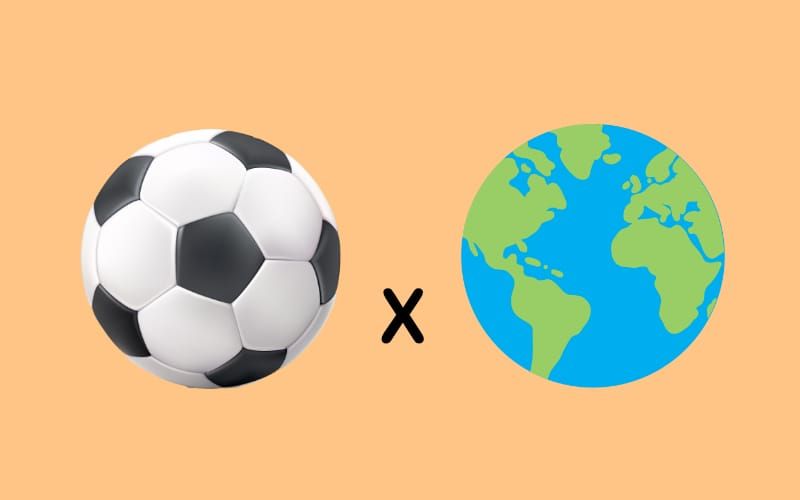
As the 2026 FIFA World Cup comes to a close, I keep thinking that this might be the last one – and I’m surprisingly at peace with it. Please know that this is not easy for a Brazilian like me to say, being that I grew up living and breathing football like most Brazilians. It's been a long and painful process for me to see the reality of FIFA’s corruption, how racist the sport I love has become, and what it means to put together a resource-intensive event of this magnitude during a climate crisis. And now that I see it all, I just can’t unsee it.
If you know anything about us Brazilians, you know how passionate we are about samba and football – what Americans (and only Americans) call soccer. Brazilians pour as much time and energy into football as Americans put into baseball, basketball, hockey and American football combined, I’m not kidding. If you want a glimpse of it, check out Ronaldinho: The One and Only on Netflix. Football is our national pastime, and our players are some of the most gifted out there, partly because pretty much every Brazilian kid’s first toy is a soccer ball. We Brazilians grow up playing football with our siblings, cousins, neighbors, in school, after school, on weekends, on family holidays, and every chance we get. You could call it an obsession – one that produced such national heroes as Pelé, Garrincha, Jairzinho, Bebeto, Romário, Ronaldo, Ronaldinho, Neymar, Vini Jr. and so many others. It’s no wonder that Brazil is the only national team to have played in all FIFA World Cup editions. It’s also why every four years the country stops everything to watch our national team play on the world stage – I’m not exaggerating when I say it’s the highlight of our lives. We take this shit seriously, perhaps too seriously even.
Prior to the Qatar shitshow in 2022, I had watched every FIFA World Cup since 1986, collecting incredible memories that I’ll forever cherish. My family would gather around the TV to watch every game, and we would all dress up in our yellow and green jerseys, waving our giant Brazilian flag in the living room or the backyard or wherever we happened to be watching a game. When Brazil scored a goal, we would jump off our seats and scream “GOOOOOOAAAALLLL” in unison, and we could hear the entire neighborhood erupt in the same sound. It was absolutely electrifying. As a kid, those moments filled me with pride and joy for my country, and made me feel deeply connected to my people. When we lost a game, the collective sorrow felt like a giant dark cloud enveloping all of us, and we would process it together, talking about it with family members, friends, neighbors, and even strangers at the supermarket. Football dictated our country’s mood, for better or worse, and that was especially true during a World Cup.
I particularly remember the 1994 World Cup, as a teenager in Brasilia, getting to celebrate in the streets with thousands of other Brazilians after every win, and feeling that deep sense of connection with every stranger around me. The energy of those days is impossible to fit into words. It had been a tough year for Brazilians, watching our beloved Ayrton Senna die in a F1 car crash on live TV in May. The country had been in mourning for weeks, and the collective grief was palpable everywhere you went. When the World Cup started, it was hard to get in the mood to celebrate at first, but our amazing 1994 “seleção” (what we call our national team) displayed incredible unity and reminded us that unbridled joy is also a Brazilian trademark. Every goal got us closer to the final and our spirits more alive, and every celebration in the streets afterwards brought us closer together as a people. When our team won the World Cup and dedicated it to Ayrton Senna, the whole country erupted in tears of joy and sorrow, an unforgettable cocktail of emotions forever imprinted on the fabric of our nation. We partied on the streets for days, and when the champions returned to Brazil, we gave them a proper welcome that I will never forget. I got to see them up close, with Dunga (our team captain) holding the cup, and Romário, Bebeto, Branco, Taffarel, Cafu, Viola, and the rest of the team behind him. The stuff teenage dreams are made of, really.
Another memorable one for the books was the 2002 World Cup, when I was already living in the United States. It was my first time experiencing the World Cup outside of Brazil, and I was shocked to see how Americans cared so little about it. Luckily, my other Brazilian, Latinx and European friends cared as much as I did so we watched the games together in the middle of the night, since the matches were taking place in South Korea and Japan, about 13 hours ahead. These were the times before hybrid work was a thing, so we had to get creative to be able to watch all the games. We would set our clocks to wake up in the middle of the night when it was still pitch-black outside, and sometimes watch the games wearing our jerseys as pajamas then head straight into work afterwards. On the weekends, we would meet up at a friend’s place around 2am to watch the games until we crashed on the couches and floor after being glued to the TV all morning, only to wake up later in the afternoon and party the rest of the night to catch the next set of games. That was some dedication, I’ll tell you, and we were rewarded with amazing game performances across the board. As for our 2002 seleção, despite receiving a lot of criticism for not including the 1994 champion Romário in the roster, they quickly solidified their presence in the tournament, and advanced to the finals to beat Germany 2x0. We were absolutely out of our minds with joy, and took to the streets of Tampa to celebrate with other Brazilians and our Latinx hermanos and hermanas. People decorated their cars with flags and were cheering, playing loud samba, honking... but we were the only ones making all the noise. Folks passing by us were scratching their heads trying to figure out what was going on because the World Cup was simply not a thing on their radar. It was sort of hilarious, and it put things in perspective for me. These games, that had been the center of my life, were perhaps not as important as I thought.
As I continued to examine and question all my habits, beliefs, preferences and privileges (hello, adulting), I also started studying sustainability and that was a major turning point. I started seeing the role of sports as a circus meant to distract the masses from social and political hardship and stall progress. I started seeing the huge environmental cost and the illusion of it all. It became harder to enjoy the game I love. It didn’t help that the 2014 World Cup took place in Brazil and billions of dollars were wasted building infrastructure for the games (7 of the 12 stadiums used were newly built) – money that should have gone to healthcare, education, transportation and other things Brazilians actually need to survive. It also didn’t help that our beloved Brazilian colors had become associated with Bolsonaro supporters, our version of the MAGA cult followers. And it most certainly didn’t help that our team suffered a humiliating loss to Germany in the semi-finals in such traumatic fashion that we even gave it a nickname – Mineiraço. The combination of all that felt like a major turn off, and I just couldn’t shake that feeling.
That’s why in 2022 I boycotted the World Cup for the first time. The Qatar edition was wrapped in so much controversy – from the bribery allegations and migrant deaths to build stadiums in the middle of the desert, to the silencing of critics and discrimination against women and LGBTQIA+ folks – that it all just became too much for me. I couldn’t bring myself to participate in such a deplorable circus knowing what I knew. And you know what? I honestly didn’t miss it. I spent my time focusing on other things, and every now and then would check on the scoreboard just to see how the Brazilian team was doing. I didn’t wear my jersey a single time, or wave my Brazilian flag. It felt weird at first, but I adapted. Because that’s what evolution requires of us: adaptation.
Leading up to this year’s World Cup, I spent months in agonizing grief and anticipation for it, because this time the circus was coming to New York, where I live. The Qatar games were easy to ignore because they happened far away. I wasn’t sure how things would play out here in my backyard. I felt conflicted about engaging with the circus at all, knowing that this would be the most polluting World Cup to date as the tournament expanded from 32 to 48 teams, increasing the quantity of matches across 16 cities in 3 countries and thus requiring more travel. Global carbon accounting platform Greenly estimated this World Cup would generate 7.8 million tonnes of carbon dioxide, while Scientists for Global Responsibility estimated that figure would surpass 9 million tonnes, or the equivalent of annual emissions for 2 million cars (USA) or 6.5 million cars (UK). That’s almost double the average emissions for the past four World Cups, and it’s absolutely ridiculous. We are at a point where we should be cutting emissions to avoid further rises in global temperatures, not generating more emissions. But what else could we expect from FIFA after partnering with Aramco, the world’s largest corporate greenhouse gas emitter? Just more greenwashing, of course, and sponsored by Big Oil, of course.
Besides the usual corruption, racism and bootlicking, this time around there was also the health aspect, since COVID reframed everything. There was a part of me dying to join the Brazilian fans in public watch parties, and another part of me wanting nothing to do with these superspreader events. As an immunocompromised person, joining the crowds coming from all over the world would pose significant risks to my health, and those risks outweighed the benefits. I know most people have decided to pretend that we’re still living in 2019, but that’s just make-believe. As scientists have warned us for ages, climate change brings about increased risks of disease outbreaks, and international events of this scale can be deadly culprits. For that reason, I opted to watch most of the games at home. I twice joined small-scale watch parties, but they were not really accessible and left me feeling vulnerable and frustrated, which was not the goal (pun intended). More than anything they served as painful reminders of how ableist and selfish our society currently is, and made me realize I don’t miss extremely loud, alcohol-fueled gatherings that offer a momentary, superficial sense of unity and community only to leave me feeling empty and depleted afterwards. I’d rather have the real thing now, where people actually care about themselves and each other in tangible ways such as wearing good quality respirators, having accessible entrances, exits and bathrooms, being transparent about ingredients in food and drinks for those with allergies, and not vaping or smoking around others. That’s what real community looks like – people looking out for one another and not leaving anyone out.
In the end, I did give this World Cup a lot more of my time than I wanted to, but at least I didn’t give it any of my money. I’m glad I didn’t spend thousands of dollars to support this circus – game tickets ranged from the elusive $60+ for Group Stage, to $32,970 for the final thanks to "variable pricing”… and that’s not factoring in the costs for transport, accommodations, food, etc… talk about inaccessible. I’m glad I didn’t buy any merch or memorabilia or a FOX subscription. I’m glad I didn’t materially support the systemic fraud that is FIFA, despite all their PR campaigns claiming otherwise. I was disgusted by the favoritism displayed towards VARgentina (especially in the Cape Verde and Egypt games), by the red card reversal to appease the orange clown, by the local impact to communities, and that’s on top of the usual lack of transparency, consistency and accountability. But the main reason I feel this might be the last World Cup is because the amount of resources to produce such a massive spectacle is simply no longer sustainable.
Millions of people flying in from all over the world, some teams even flying in their food, all the waste from the event marketing materials (those giant vinyl printouts that will likely end up in landfills), all the trash generated from single-use everything… at what point do we say ENOUGH? The temperatures are climbing, the fires are raging, the pathogens are multiplying, and we’re just playing along waiting for a miracle to happen – but no one is coming to save us. We all share a collective responsibility over the state of this world and what happens next. We can’t just keep shrugging things off, normalizing this insanity, or making excuses like many of the (mostly male) writers linked here seem to conclude their pieces with. I have more balls than that (ha!). I am willing to make sacrifices to live in ways that align with my values, including giving up football as it stands, because that’s what this moment in time demands of us: ACTION, not just wishful thinking or empty words. Complacency is not a survival strategy. We need to take a hard look at how we are living our lives and impacting life on this planet, because we are part of it, not separate from it.
Football is a low-emission sport by nature, with 20 players running after a ball plus two goalkeepers protecting the net. We don’t need to make it such a dirty circus. I love football too, but does FIFA need to exist? Do they need to centralize that much power with zero accountability? Does every tournament need to be bigger and more destructive than the last? Can we please pause and reassess what we’re doing here? A FIFA World Cup is not that important to the survival of our species. We are working with finite resources, and we’re burning through them way faster than we can replenish them. Things need to change, and fast.
That said, in case I’m wrong and this is not the last World Cup, and FIFA does somehow manage to pull together games in 6 different countries in a burning planet four years from now, I won’t watch it but I hope Brazil makes it to the final against Argentina to put their rivalry to rest, and I hope we send them home with a 4-1 score as an ode to our glorious 1970 seleção. Because I can’t help it, I’m still Brazilian.
...
NO AI TRAINING: Without in any way limiting the author’s exclusive rights under copyright, any use of this publication to “train” generative artificial intelligence (AI) technologies to generate text is expressly prohibited. The author reserves all rights to license uses of this work for generative AI training and development of machine learning language models.
Member discussion